Examples · Fictional sample memorial
A memorial page example, section by section
This is a complete example of a More Life memorial page, built for Marcus Elijah Reed (1948–2024). Marcus isn't real. We created him to show what a memorial built from stories can hold: chapters of his life, voices of people remembering him, photographs, a timeline, the things he loved and a guestbook. Below, we walk through each part and explain how a family builds it.
This is a fictional memorial. Marcus, his family, the voices, the photographs and the guestbook notes are all invented for illustration. The voice clips are illustrative AI-generated audio, not real interviews.
1. The opening: a name, two dates and a count of voices
The page opens with Marcus's portrait, his name, his life dates, and a quiet count: 2 voices · 3 photographs. A share button sits at the top.
How families build it: add a name, the years and a photo when you begin. You can come back and fill in the rest at your own pace.
See it in the sample →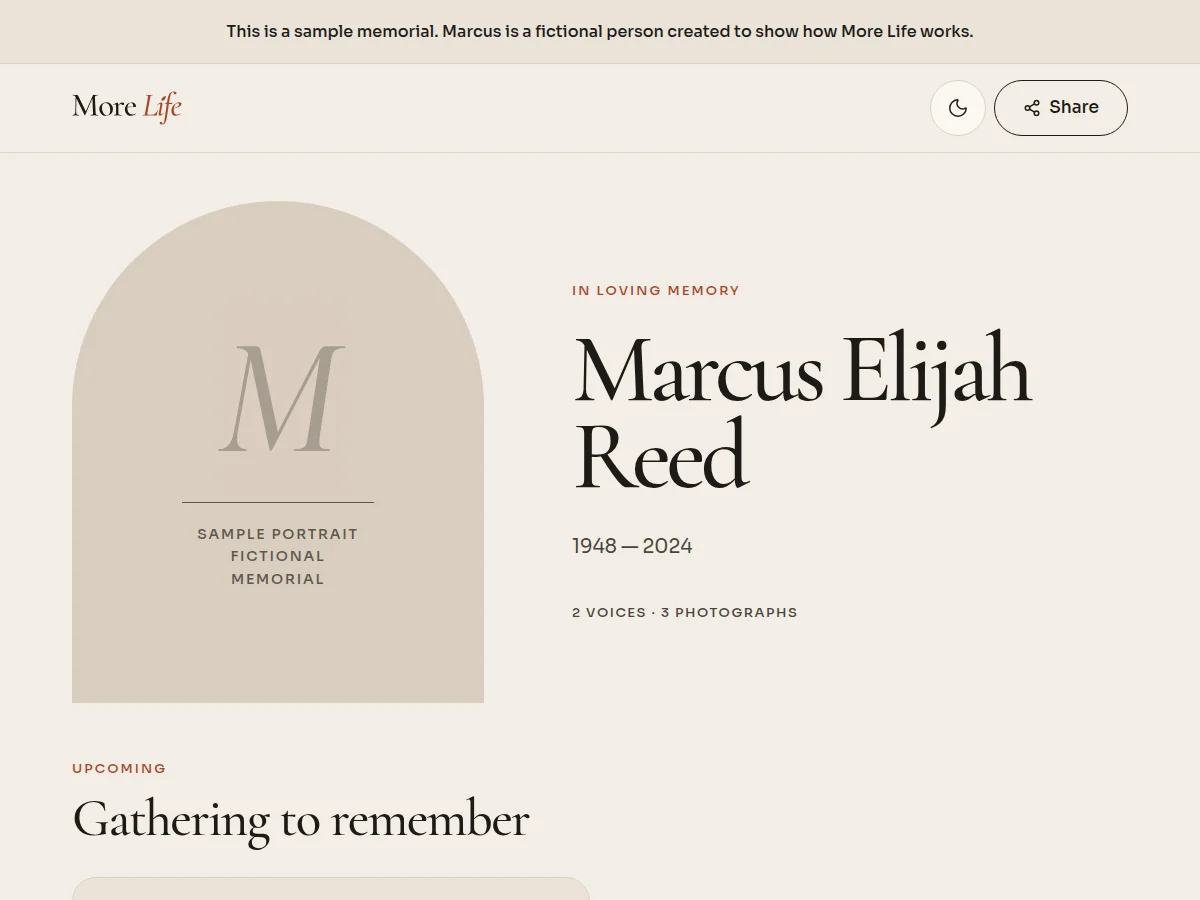
2. Gathering to remember: a celebration of life
Near the top is an upcoming celebration of life, with a date and time, a venue ("The Fictional Garden Room"), a dress code ("Garden colors welcome"), and buttons for directions, a livestream and an RSVP.
How families build it: add any service, whether a celebration of life, a funeral or a burial, with the venue, address, dress code and notes. If you have links for a livestream or an RSVP form, add them, and the buttons appear. Once a service has passed, it moves to "Past services" at the bottom of the page. Marcus's page shows a burial there.
See it in the sample →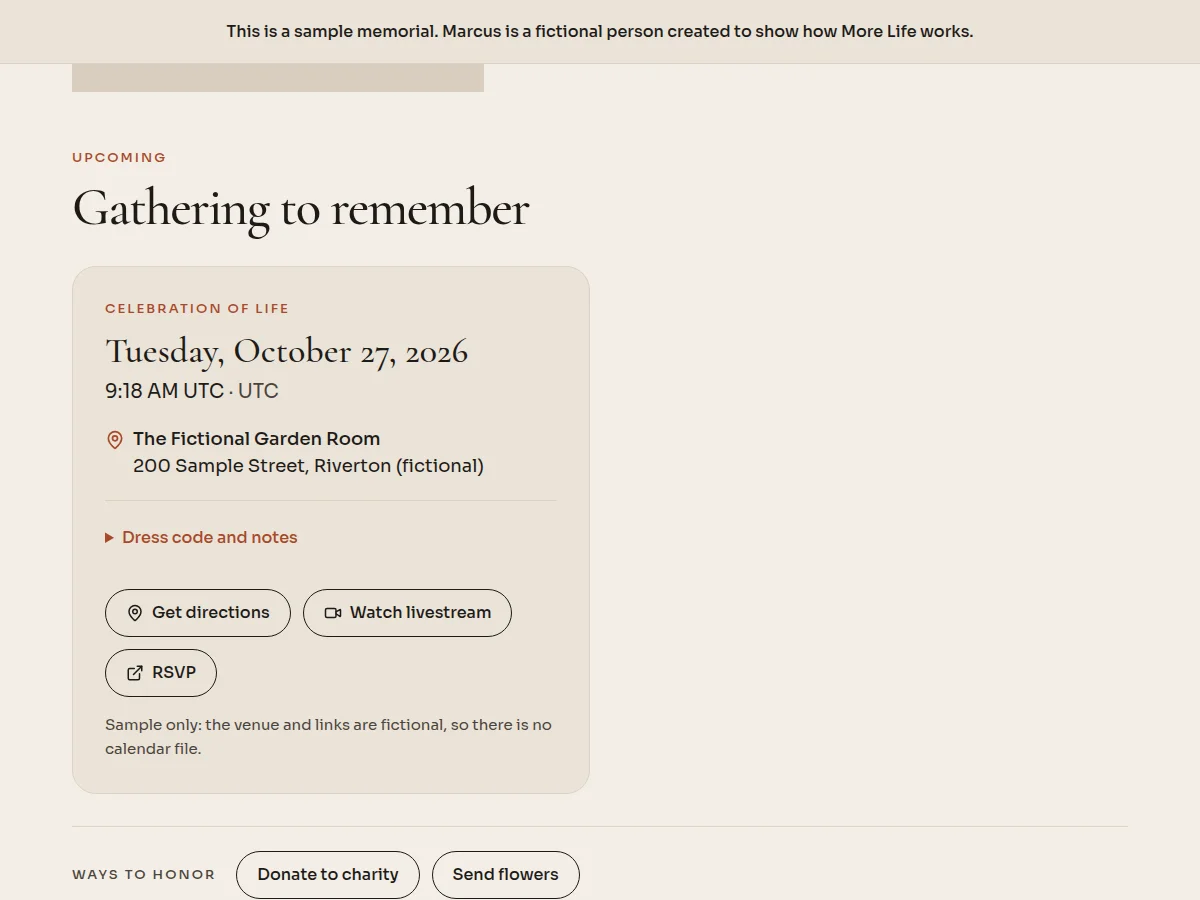
3. Ways to honor
Two simple buttons: Donate to charity and Send flowers.
How families build it: paste the link to a charity or a florist you'd like people to use. Leave them blank, and the buttons don't appear.
See it in the sample →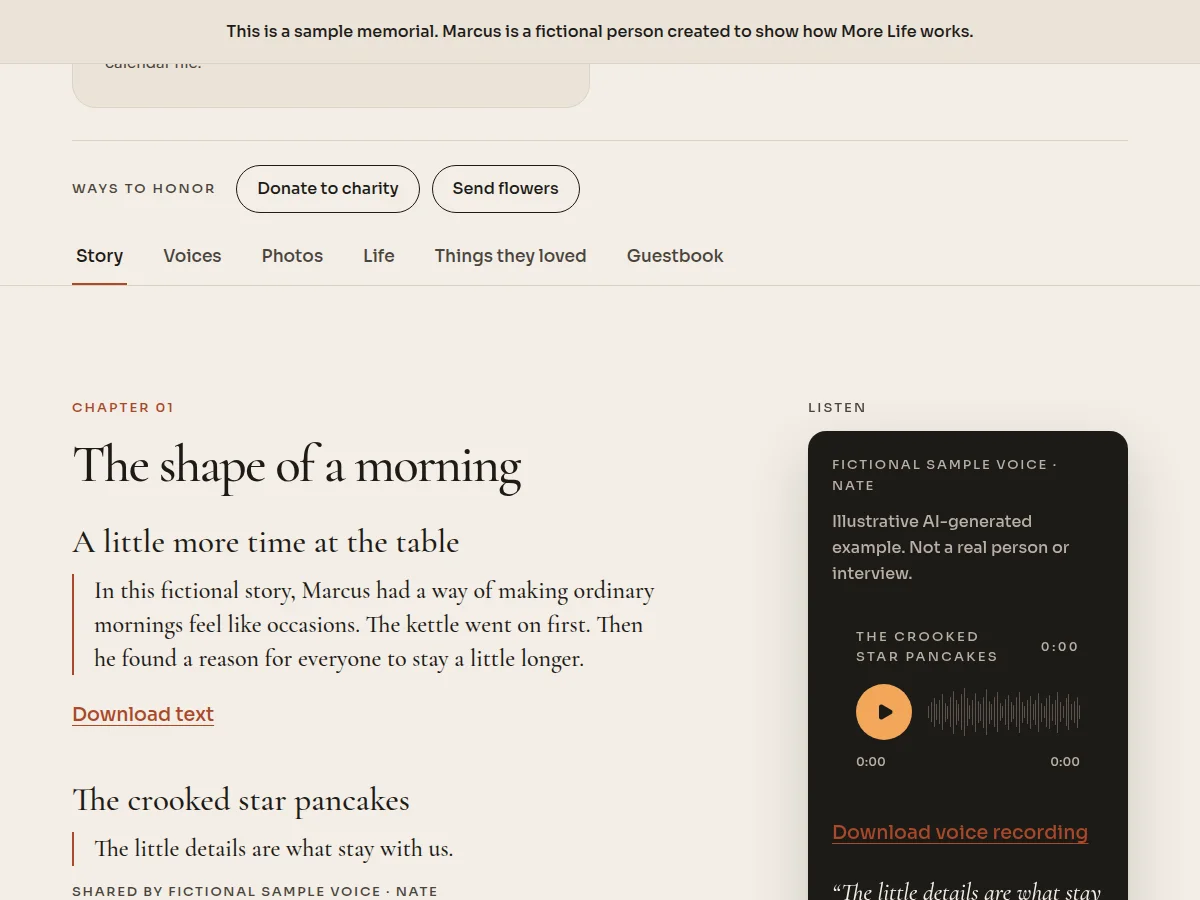
4. The story, in chapters
Marcus's story is told in three short chapters: "The shape of a morning", "The door was always open" and "What stays with us". Each chapter has a few lines of writing, and voice clips and photographs sit between the paragraphs, so the story reads like a story rather than a list.
How families build it: the story is made of blocks you drag into order: headings, text, quotes, a photograph, a small gallery, a YouTube or Vimeo video, and memories people have shared, each credited to whoever shared it. In the sample, every chapter can also be downloaded as text.
See it in the sample →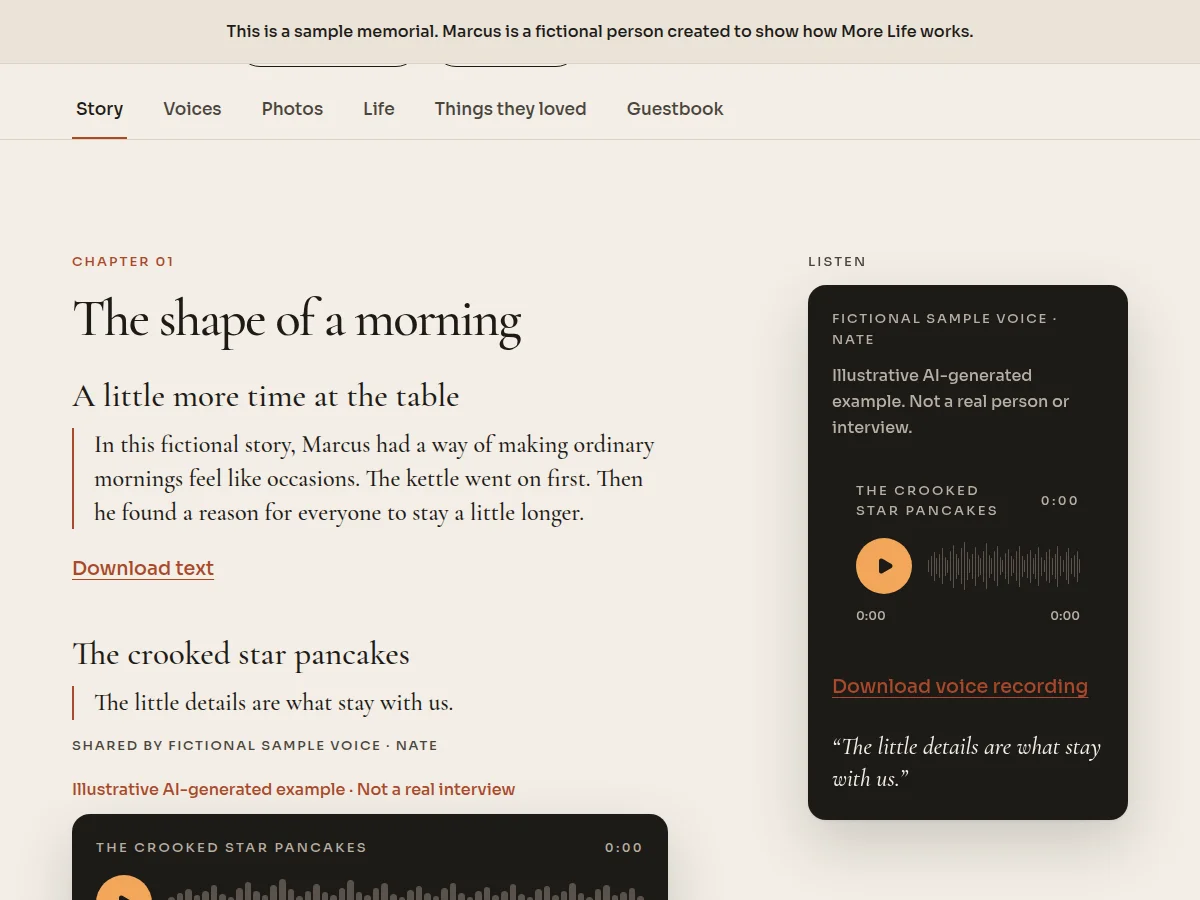
5. In their voices
The Voices tab holds two recordings: "The crooked star pancakes" and "The front garden." In the sample, these are illustrative clips voiced as Nate and Rachelle, our AI interviewers, each with a short transcript and a download button.
On a real memorial, this is where the voices of the people who loved them live: a sister, a teammate, a neighbor, recorded in their own words during a guided interview. Each recording can be listened to and downloaded.
How families build it: invite people with a private link. They don't need an account. Nate or Rachelle guides them one question at a time, and they can type or record their memories. You approve each one before it appears.
See it in the sample →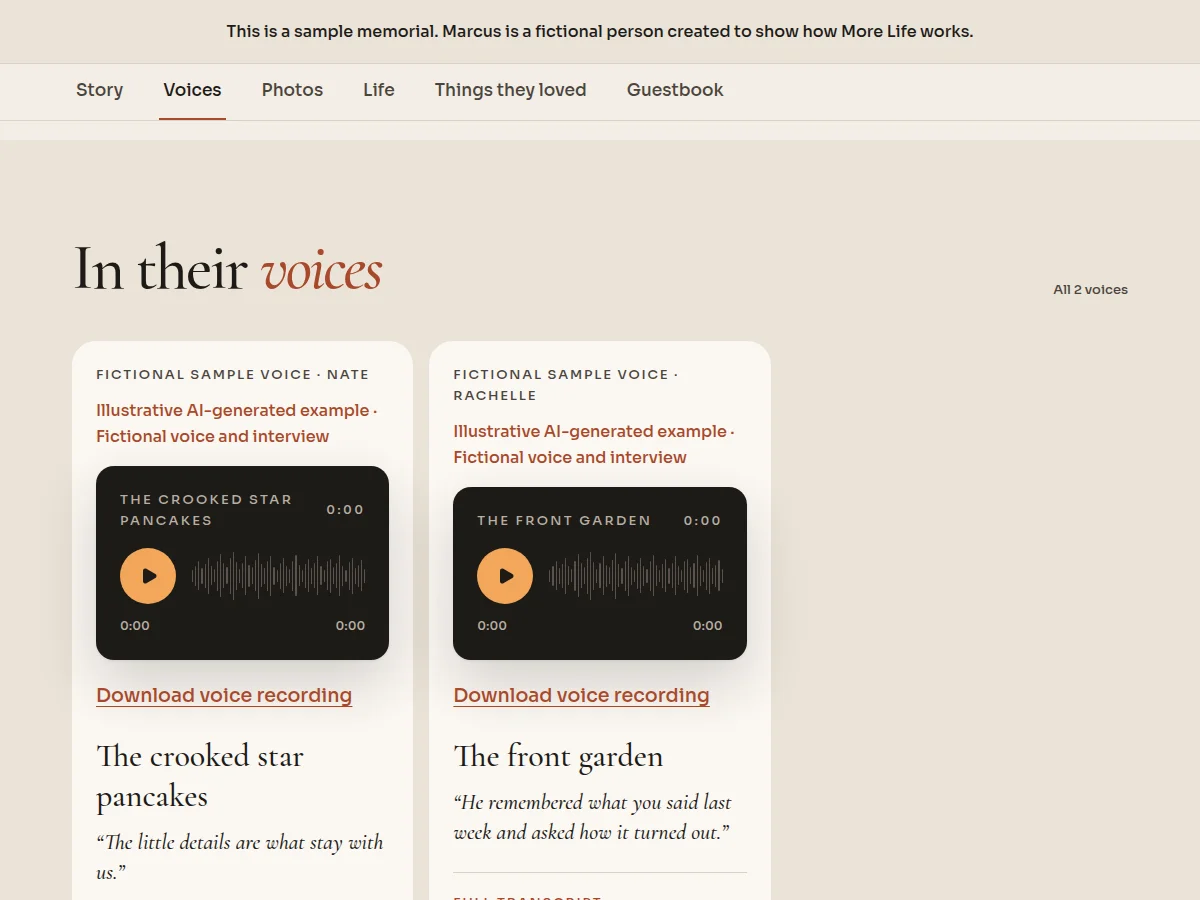
6. Photographs
Three photographs, each with a caption and a credit: "A Sunday at the kitchen table", "The garden gate" and "Gathered together".
How families build it: upload photos yourself, or let the people you invite add theirs with a caption and roughly when each was taken. You can group photos into albums. Albums appear first, and everything else sits under "All photos."
See it in the sample →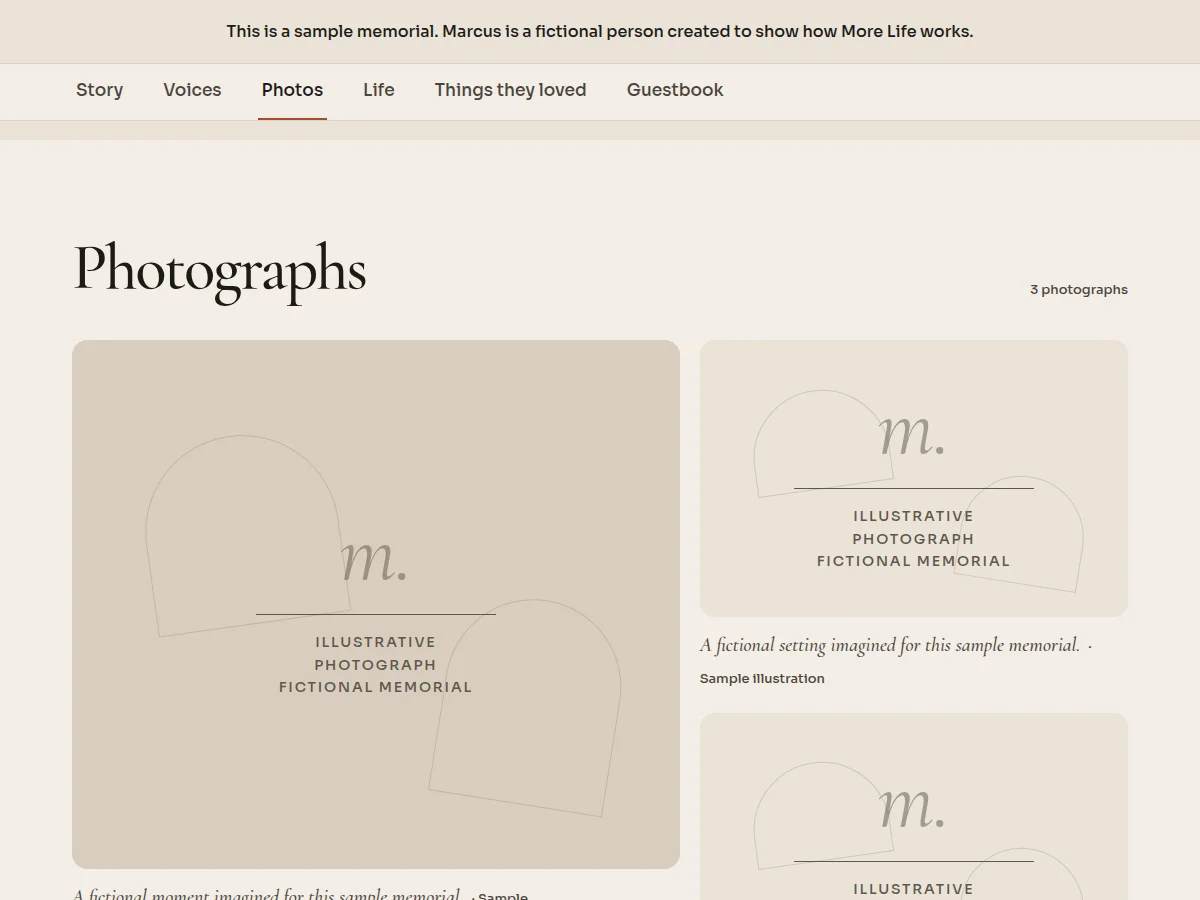
7. A life in years
A timeline arranged by decade. It starts with Born in a small river town (April 1948) and moves through Finished school (1966), Married Eleanor (1974), Opened the corner workshop (1989) and First trip to the coast (2003). Each event notes who added it, whether that was the family or someone who shared a memory.
How families build it: add events with a year, a category and a few details. You can also give a trusted person timeline access so the events they add are published directly.
See it in the sample →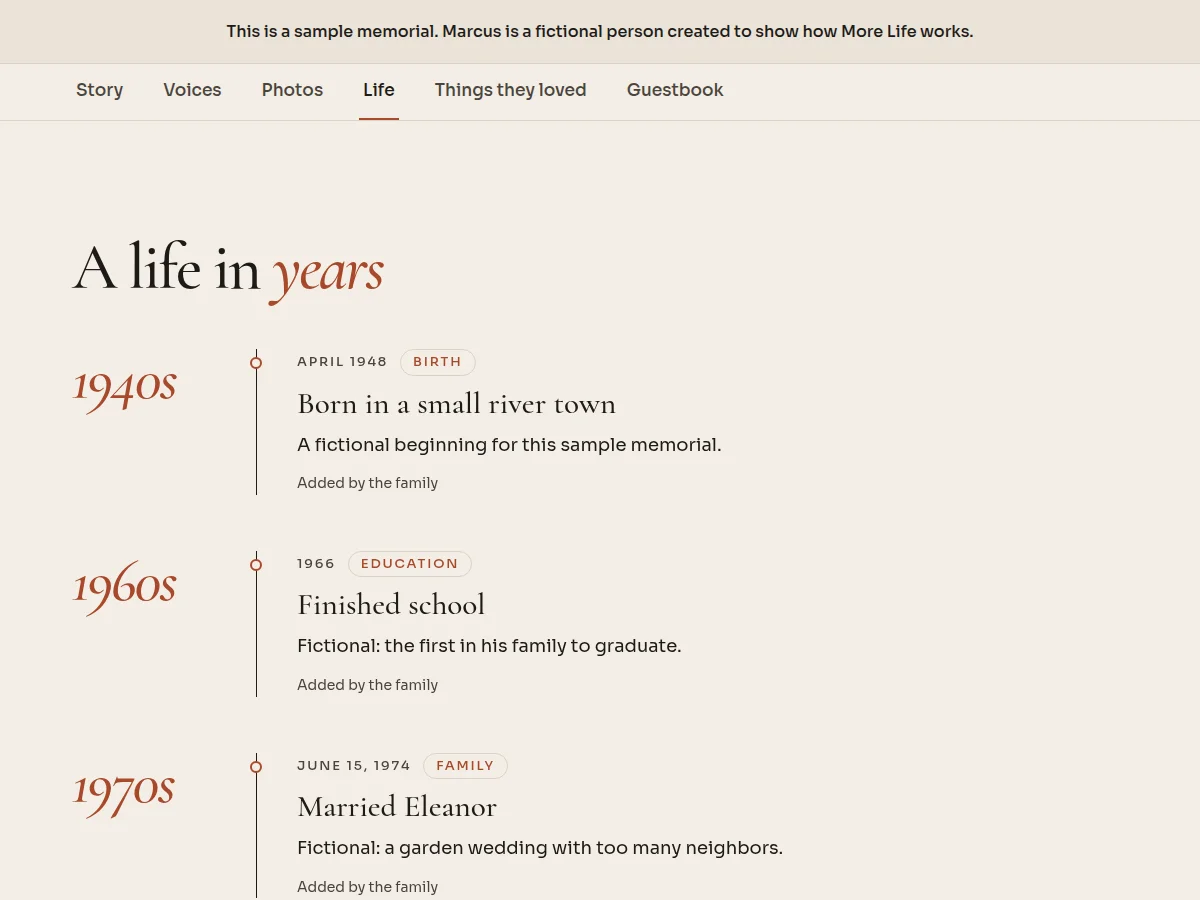
8. Things they loved
A small museum of a person: a song he hummed while the kettle boiled, a well-thumbed field guide to birds, Saturday matinee westerns, salted caramel on everything, the tide pools at the coast, the Riverton Otters ("loyal through every losing season"), a saying ("Stay a little longer.") and a hobby (repairing old clocks). There's even his recipe for crooked star pancakes, with ingredients and steps.
How families build it: you and the people you invite can add favorites: a song, a book, a film, a food, a place, a team, a saying, a hobby or a full recipe. Favorites are always reviewed by you before they appear.
See it in the sample →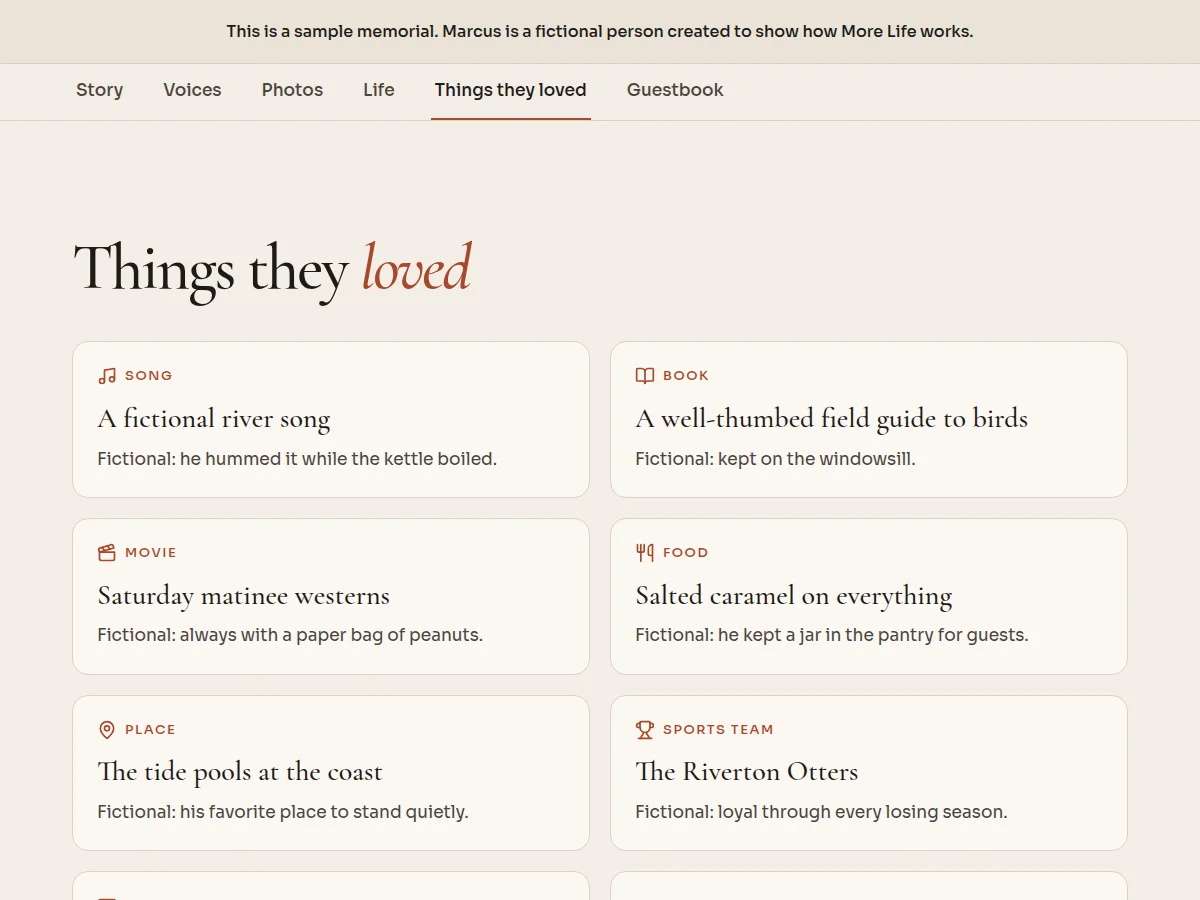
9. The guestbook
Visitors can leave a few words, light a candle or leave a flower. Marcus's guestbook has two (fictional) notes, including "the clocks still run a little fast without him", plus 2 candles · 1 flower.
How families build it: nothing to set up. By default, the family reads each note before it appears, and a candle or flower is counted only once the note is approved. You can turn on automatic approval for the guestbook if you prefer.
See it in the sample →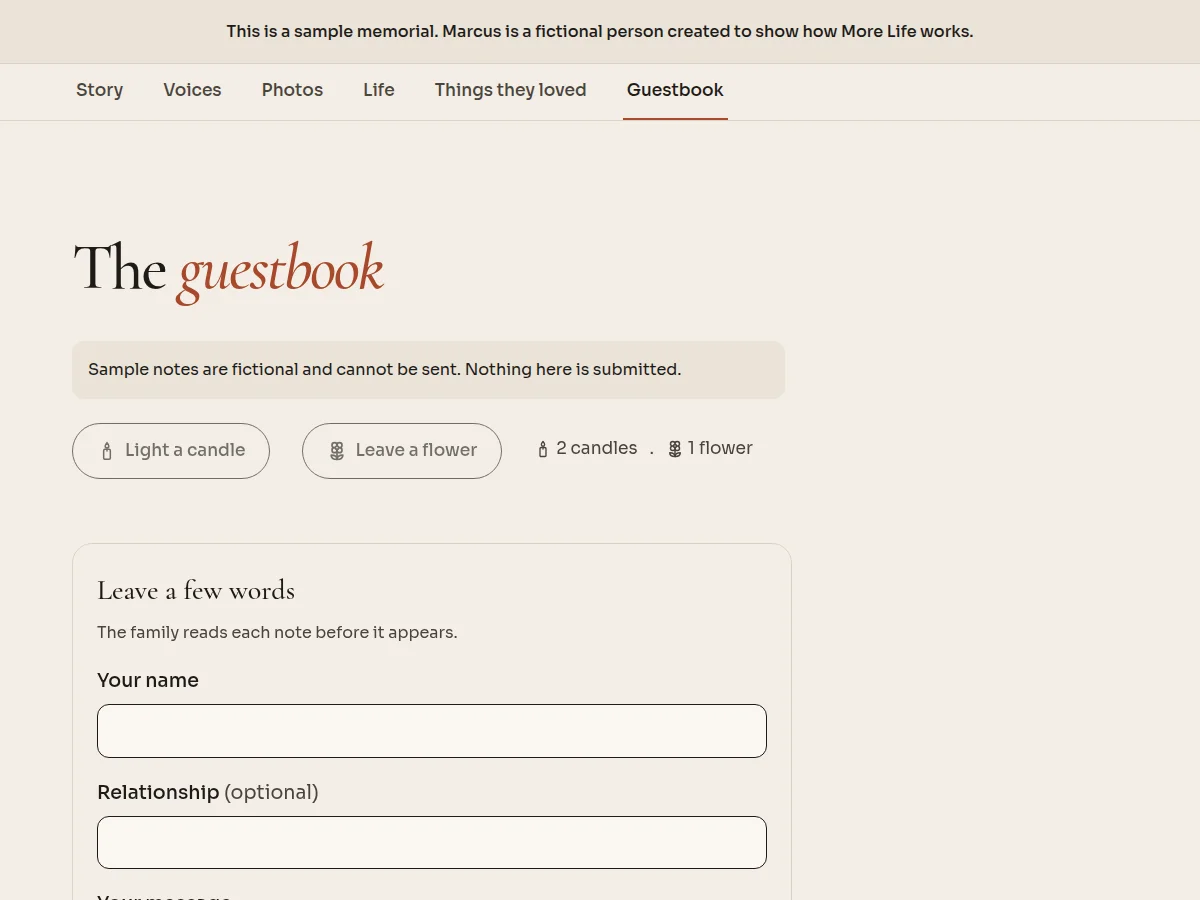
What makes a memorial page feel like them
A few things we've learned from building this one:
- Lead with a moment, not a résumé. "He turned breakfast into a ceremony" tells you more than a job title.
- Ask other people. A friend remembers someone differently from a sibling. A memorial with several voices feels like a life rather than a summary.
- Keep the small things. A saying, a recipe, a team they never gave up on. Those are what people come back for.
- Let people hear them, or hear about them. A voice carries what writing can't.
- Decide who sees it. Every More Life memorial starts private, and you choose if and when that changes.
Build one like it
- Begin a memorial for free. It's private from the start.
- Invite the people who loved them. They don't need an account.
- Approve what's shared, and choose whether to keep it private, share it by link or make it public.
The free memorial includes unlimited photos and contributors, one guided interview, and every customization feature, including albums. The Voices ($100, one-time) and The Legacy ($300, one-time) add more guided interviews and every voice recording on the memorial. No subscriptions. See plans and availability →
Questions about this example
Is Marcus Elijah Reed a real person?
No. Marcus and everything on his memorial are fictional, created to show how a More Life page works. The voice clips are illustrative AI-generated audio, not real interviews.
Can my memorial look like this on the free plan?
The free memorial includes unlimited photos and contributors, one guided interview, and every customization feature, including albums. Paid plans add more guided interviews and every voice recording on the memorial.
Can I hide sections I don't need?
Yes. You choose which tabs appear on the memorial: story, voices, photos, life timeline, things they loved and guestbook. Any service or link you leave blank simply doesn't show.
Can I add a celebration of life or funeral details?
Yes. Add any service with the date, venue, address, dress code and notes, plus optional links for a livestream or an RSVP form. Past services move to their own section.
Who can see a memorial like this?
Only the people you choose. Every memorial starts private. You can make it unlisted, which means anyone with the link can visit and a password is optional, or public, where it can appear in search.